
If you enjoy Monopoly or Risk, you already like board games — you’ve just been playing older designs that tend to feel slow, luck-heavy, or long for what they actually deliver.
Modern “gateway” board games keep what’s fun (tension, interaction, satisfying choices) while cutting the parts that frustrate new players: downtime, rule arguments, endless turns, player elimination.
Below are the 10 games I recommend most often to people making that jump, based on games I’ve actually played — physically or on Board Game Arena.
Pick your next game, fast
| If you… | Play this |
|---|---|
| Want quick, repeatable, “one more round” sessions | Sushi Go Party! |
| Play with 3–5 people and want a classic feel | Ticket to Ride or Carcassonne |
| Mostly play 2-player or 2–3 | Azul or Santorini |
| Want something social and loud | Codenames or Dixit |
| Like light strategy and upgrading your options | Splendor |
The 10 games
1. Azul
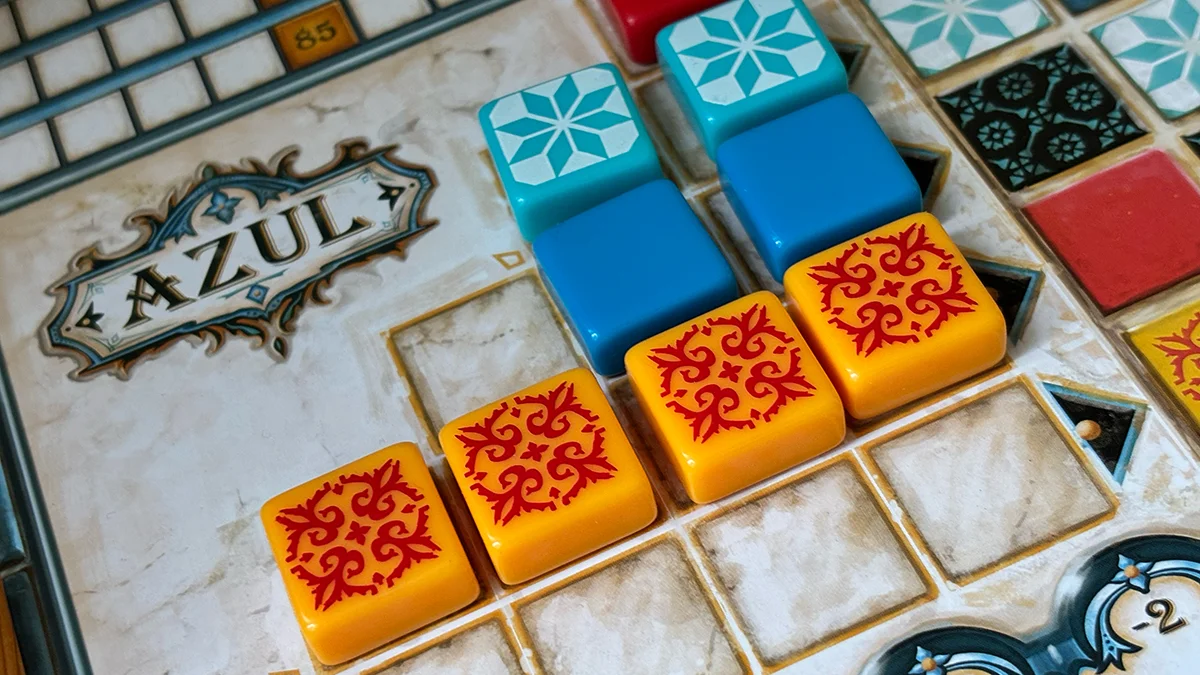
Azul is one of the most beautiful board games I’ve seen, starting with the box — and it’s no surprise, because in Azul you’re building Portuguese tile walls.
You pick tiles from shared displays each turn, trying to complete rows without wasting pieces, and score points for the patterns you build. Very few games are this simple to learn and this satisfying to get better at.
Why it works for beginners: Simple turns, satisfying choices, enough depth to stay interesting after the first game.
Skip if: You want strong theme, negotiation, or lots of direct player interaction.
My take: A great pick when you want something calm, elegant, and easy to teach.
Azul has been in my board game collection for many years and it is one of the sure winners when you want to play a simple board game in which all kinds of different people get involved, since it’s beautiful to play with, satisfying to advance and in general let’s you do your own thing. But it can also get competitive if the players are inclined that way!
Rules explanation I recommend: Teach The Table’s Azul intro
2. Carcassonne
Carcassonne is set in the real village of the same name in southern France. You’re building towns, roads, and abbeys by placing tiles, then claiming those areas with your meeples to score points.
It’s become one of the most recognizable board game franchises, with dozens of expansions that turn an already solid game into something you can keep growing for years.
Why it works for beginners: Tile placement is intuitive, and the “farmer” scoring is the only real learning curve.
Skip if: You want a game that resolves faster than 30 minutes, or you dislike area-control tension.
My take: Deceptively simple pieces, real end-game tension.
I mostly play this with friends, though it works just as well with my partner. It’s genuinely a game you can bring to almost anyone.
Two to four players feels like the sweet spot to me. With just the base game, going beyond that can start to feel a bit cluttered.
What gets me every time is the tension in the second half of a game, when you’re trying to close out a huge city and you’re not sure it’s going to happen. The first few times, for me, it didn’t, and losing all those points at once stings.
What actually surprised me is how simple the components are: classic meeples and cardboard tiles, nothing more. Yet it’s one of the games that gets people enjoying themselves the fastest, probably because that same simplicity makes it so easy to just sit down and start playing.
📷 FOTO: tu copia física o una partida
3. Catan
Catan is the classic of classics — the most-played modern board game ever, and for a lot of people (including me) the game that turned “I play Monopoly sometimes” into “I collect board games now.”
You settle an island, gather resources, trade with other players, and build roads, settlements, and cities to accumulate points across the game.
Why it works for beginners: The trading mechanic makes every turn interactive, even when it’s not your turn.
Skip if: You want a shorter session or dislike negotiation-heavy games.
My take: Still the reference point for a reason — it’s the game most people already have an opinion about, and it usually earns that opinion.
My first Catan memory goes back more than ten years, but it was Board Game Arena that made it the game that kept my partner and my best friend connected despite living half a continent apart.
📷 FOTO: partida de Catan, física o captura de BGA
4. Codenames
Codenames is a word game where two teams of spies race to contact their agents hidden across a 5×5 grid of words. Each team’s spymaster gives one-word clues to point their teammates toward the right words — before the other team gets there first, or before someone accidentally picks the assassin.
Why it works for beginners: Zero setup complexity, and even people who “don’t like board games” tend to enjoy it.
Skip if: You’re playing with only 2–3 people — it needs the team dynamic to shine.
My take: Better with a big, mixed group than as a two player game.
I mainly play this with larger groups, and honestly, almost any mix of people works. It gets especially fun when the group is very different from each other: different ages, different nationalities, that kind of thing.
There is a two player version, but in my experience the game really comes alive with a bigger group. That is when people can actually discuss the words on the table, argue their case, and put different interpretations side by side.
One piece of advice from a memorable disaster: be careful with humor around people who do not know you well yet. A joke that landed wrong during a game with my partner’s family ended with a glass of wine spilled over the table, ruining a chunk of my cards for good. They still cannot be used.
The first time I played, I was not that impressed visually. It is just small cards with a single word on each, so it looked a bit dull on the table. But it turned out to be a game that makes you think hard, and it is genuinely funny how often you realize you do not know the language as well as you thought.
📷 FOTO
5. Dixit
Dixit might be the most beautiful card game I own. The art is genuinely otherworldly — that’s not an exaggeration, the illustrations really do feel like they’re pulling you into another place.
On your turn you describe a card in your hand with a word, phrase, or sound — vague enough that some players guess it, but not everyone. Other players submit cards that could also match your clue, everything gets shuffled, and everyone guesses which card was yours.
Why it works for beginners: No rules friction at all — the entire game is one creative decision per turn.
Skip if: Your group prefers competitive strategy over open-ended creativity.
My take: More fun with strangers than with close friends.
You would think Dixit is the ideal game to play with people you know well, since you can lean on shared references and inside concepts. But I actually find it more fun with people I do not know, trying to understand them through the concepts they associate with each card.
What still surprises me, even after years of owning the base game, is how beautiful it is and how much you can pull out of the cards. I keep noticing small details in the artwork I had never spotted before.
📷 FOTO
6. Munchkin
Munchkin is a card game that parodies Dungeons & Dragons and other dungeon-crawling RPGs — and it’s become a huge franchise in its own right, with dozens of themed versions.
The goal is to level your character from a weak level-1 nobody to a level-10 hero, fighting ridiculous monsters and looting absurd treasure, all while doing everything you can to sabotage the other players — with a heavy dose of humor.
Why it works for beginners: The rules are simple; the fun comes from the jokes and the sabotage, not from mastering mechanics.
Skip if: Your group doesn’t enjoy player-vs-player chaos, or you want a predictable game length.
My take: TU NOTA
If you’re curious about the Dungeons & Dragons references Munchkin is joking about, that’s covered on Learning to Roleplay.
TU NOTA
📷 FOTO
7. Santorini
In Santorini you build white-walled, blue-domed towers on the Greek island it’s named after — with the help of a god power that bends the rules slightly in your favor.
The theme alone would be enough to sell me, but it also happens to be genuinely excellent: it’s so quick to play that you’ll spend more time setting up the little plastic cliffs than actually playing.
Why it works for beginners: Fast, visual, and easy to read the board at a glance.
Skip if: You want a longer session or resource management instead of pure spatial strategy.
My take: A game I am still waiting to play in person, and cannot wait to.
So far I have only played Santorini online, against strangers. But it is such a simple and beautiful game that I am really looking forward to trying the physical version with friends and family.
The god powers feel counterintuitive at first. After a few turns, they start to feel essential.
If you ever enjoyed block based games like Tetris, you will probably enjoy Santorini too, even though the two have nothing in common on the surface.
📷 FOTO
8. Splendor
Splendor puts you in the role of a jewel merchant building a trading empire. You use gem tokens to acquire development cards, which in turn generate more gems and prestige — snowballing toward the points you need to win.
Why it works for beginners: The rules fit on one card, but the decisions get genuinely interesting once you’re a few turns in.
Skip if: You want direct player interaction — this one is mostly a race, not a fight.
My take: Simple to learn, surprisingly hard to find a winning strategy for.
Another good rules overview: The Rules Girl’s Splendor review
I have played dozens of games of Splendor with my partner, plus quite a few on Board Game Arena against strangers, and some at home with friends.
Something I have noticed: whenever I pay close attention to the nobles, I seem to lose. Other times I completely forget they exist, and that seems to go better.
Despite how simple the rules are, figuring out a winning strategy is genuinely tricky. That is what keeps you feeling like a Splendor newbie for a lot longer than you would expect.
📷 FOTO
9. Sushi Go Party!
Sushi Go Party! might be the cutest board game on this list, and it’s also one of the most reliable. You’re at a sushi buffet, drafting cards from a shared hand and passing the rest along, trying to build combinations that score more than the sum of their parts.
It’s the bigger sibling of the original Sushi Go!, with more menus, more cards, and more customization — which actually makes it easier to keep on the table long-term, since it rarely feels repetitive.
Why it works for beginners: Nearly impossible to teach wrong, and short enough that “one more round” is always an option.
Skip if: You want a game with more strategic depth for repeat plays over months.
My take: This is one of the games that almost never fails.
I have played this a lot over the years. My original copy is actually Sushi Go, my brother’s version, not Party. My mother used to smile so much every time we played it together. Those games are something I will never forget.
Most people who try it for the first time fall in love with the cards themselves, all those little dishes from Japanese cuisine, and do not even realize they are playing a card drafting game. All they know is that, like Pokemon cards, they want to collect them all.
📷 FOTO: tu copia física o una partida
10. Ticket to Ride
In Ticket to Ride, you’re building the longest train routes you can across a map — originally the United States, though there are now many editions with different maps. You collect train cards by color, use them to claim routes, and complete destination tickets for bonus points.
Why it works for beginners: The core loop (collect cards, claim routes) is understood in one explanation.
Skip if: You want something with negotiation or direct confrontation — this one is mostly a parallel race.
My take: A physical copy of a game I already know very well.
Even though I only just bought the physical version, I have played Ticket to Ride dozens of times already, both online and in person, especially on Board Game Arena with my partner.
Buying it was an easy decision. It is one of my partner’s favorite board games, and it happened to be on sale.
The original US map edition is the game I have lost the most on Board Game Arena. My partner is just that good at it. If you are a fan of trains or travel, this one will resonate even more.
📷 FOTO: tu copia física de Ticket to Ride
What makes these good “next step” games?
Calling a game “the easiest for beginners” is a personal call. Here’s the criteria I actually use:
- Easy to teach in 5–10 minutes
- Plays well with beginners — no “gotcha” rules that ruin a first game
- Strong decisions without heavy complexity
- Consistently fun at the player counts people actually have
A note on how I write these: every game above is one I’ve played myself, physically or on Board Game Arena, with real people — not just read about. Where I don’t yet have a strong personal story for a game, I’ve marked it, and I’ll fill it in as I play more.
Using the Amazon links in this article helps me keep working on Board Game Newbie, at no extra cost to you. Thanks for reading, and I hope to see you at the table.